Optimized for Yesterday
Why Broadway is Paying Google for the Audience It Already Has

About a month ago, BroadwayWorld ran a piece by Rachel Schmaier titled “AI is Already on Broadway — Just Not Where You’re Looking.” Her argument: Broadway’s relationship with artificial intelligence is already deeper than most people realize. Not on stage, not in the rehearsal room, but inside the marketing infrastructure, the forecasting tools, the ticketing algorithms. Marc Jablonski, Vice President of Business Strategy at AKA NYC, supplied the pull quote: “One could argue that all marketers on Broadway are already using AI. They just don’t necessarily call it that.”
I ALSO interviewed Marc a month ago. Same chair. Same dataset. Similar questions — for a an MFA paper I sank more time into than my actual finals.
Schmaier is right that AI is already inside Broadway’s marketing operation. What she doesn’t say is that its fixing the problems that show up on dashboards, but making the one problem that doesn’t show up worse, faster, and with better-looking charts.
The Google Tollbooth
Imagine you own a restaurant. Not Michelin-star (let’s not get ahead of ourselves) but a legitimate neighborhood Italian place in Ridgewood where the carbonara is genuinely great and the same people have been coming for thirty years. You have regulars. You know their orders. The guy who gets the osso buco and says it’s not like Italy has been saying that since 1994. You have fully memorized the cadence of his complaint.
Then your marketing consultant, Amanda, walks in with a chart.
“You have a Google problem,” Amanda says.
“What Google problem?” you say.
“You’re paying for ads,” she says, in the tone of someone who has done this before and found it doesn’t get easier, “every time someone Googles your restaurant’s name.”
“That sounds great!” you say. “I want to come up on Google.”
“These people,” she says carefully, “were already coming.”
You stare at each other across the pasta station for a very long time.
This is Broadway’s branded search problem.
In a recent campaign, Marc pulled up an anonymized dataset from a show I’m not going to name. Two lines on a graph. One tracked paid search — people who clicked a sponsored Google ad to reach the ticketing page. The other tracked organic — people who clicked the free result one centimeter below it. The paid line went up. The organic line went down by the identical amount. Total traffic never moved. Not a single incremental visitor. Thirty thousand dollars, paid to Google, to route the show’s own existing buyers through a toll booth the show built for itself on its own driveway.
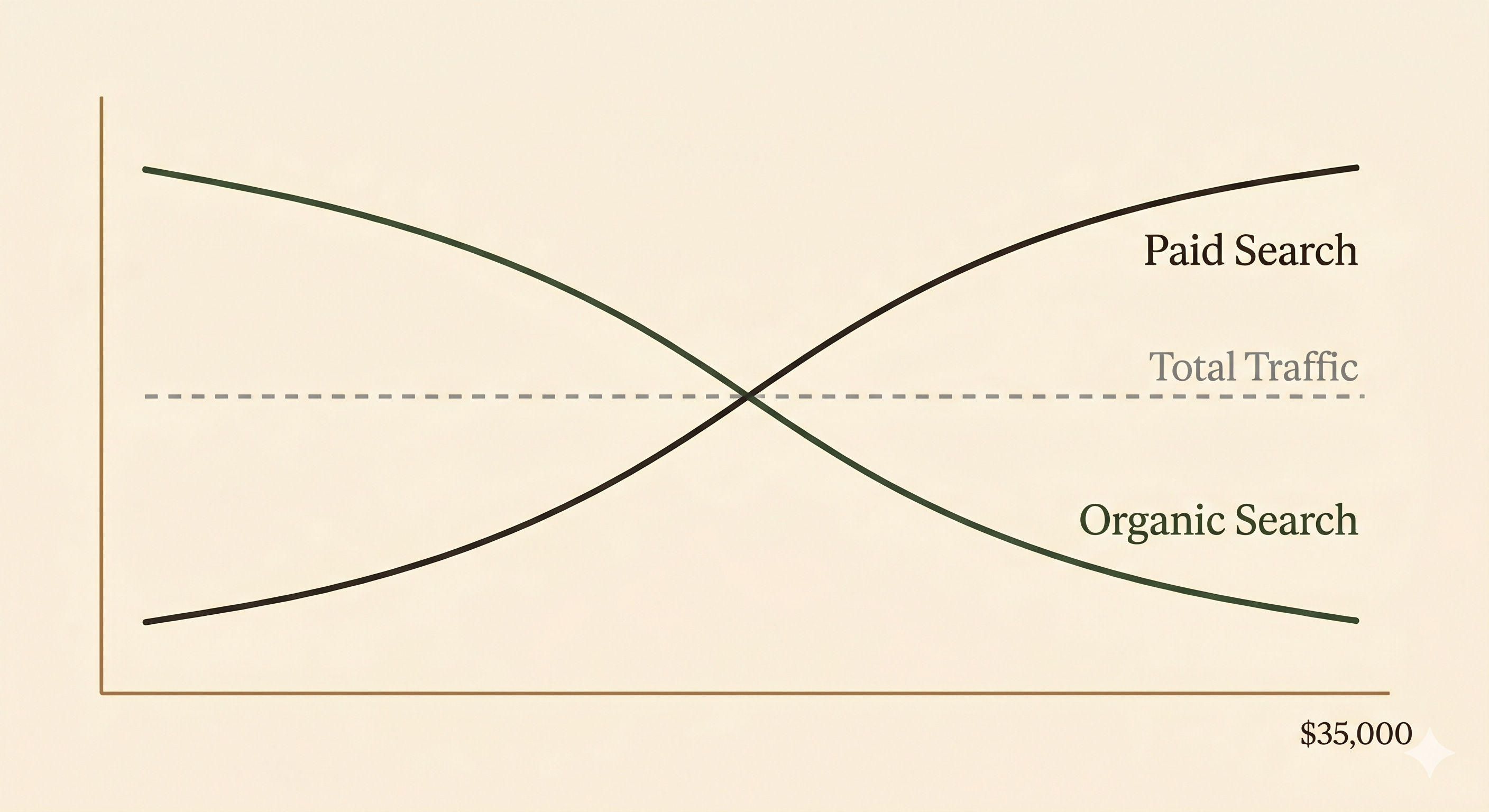
“We showed this to the client,” Marc told me. “The budget didn’t change.”
It gets more absurd. A show’s official website, its primary ticketing partner, and multiple secondary resellers are often all bidding against each other on the same keyword simultaneously. The show, TodayTix, Broadway.com, StubHub — four entities in the exact same revenue ecosystem, driving up a Google auction price to appear above each other when someone types the show’s name. Someone who, in many cases, already has her credit card out, because searching for a show by its exact name isn’t how anyone discovers a show. It’s what you do after your friend texted you about it, after you saw the review, after the slow three-month process by which Broadway actually sells tickets. The ad intercepts her at the finish line and charges the show for the click. The production funds every bid in this auction, directly or through commission structures, which means the only entity at this table with nothing to lose is Google. Marc described it to me as the industry spending money to lose a race it invented.
The official defense of branded search is that if a show stops buying ads on its own name, a reseller can buy that keyword and appear at the top, collecting a commission the show would have kept. Pay Google or pay StubHub — you’re paying either way. Marc’s substitution data shows the buyer who would “defect” to the reseller is, in the campaign records, the buyer who would have found the official site anyway. His term for the spend: pricing the anxiety rather than the risk.
I understand why producers don’t rush to cut it. When you’re spending $800,000 a week to keep a show running and your investors are watching every Monday gross, experimenting with the marketing budget feels like Russian roulette with other people’s money. You need the sure thing. The reliable tourists. You cannot afford four weeks of “finding a new audience.”
But currently, this is the performance of a sure thing, made convincing by a report that says it’s working.
The $30,000 in branded search is routing your existing customers through a slightly more expensive door. The case for cutting it isn’t idealism — it’s tactical reallocation. One of the most effective campaigns Marc described was a targeted affinity night: every ticket priced at $80 to $100, marketed exclusively to Black community organizations, no premium inventory touched, sold out completely. That is not a charity initiative. That is untapped demand sitting one block from your front door. The money currently being fed to Google to intercept your own audience could fund that instead — and probably generate a first-time buyer you’ll be able to track for the next decade.
The Blindfold
Amanda has a second job. She’s not just managing the toll booth. She’s trying to find new customers — people who don’t know your restaurant exists and might love the carbonara if they just knew it was there. To find them, she uses a tool that studies your existing regulars, builds a profile of who they are, and goes hunting for matching strangers.
“Great,” you say. “Who are my regulars?”
Amanda pauses.
“You have receipts,” she says.
Broadway’s version of receipts is ticketing data — who showed up and paid, organized however the last producer’s marketing director felt like organizing it. The algorithm trained on that data knows one thing well: who the existing audience is. So it goes out and finds more of them.
Marc’s team has spent years building AKA’s proprietary first-party database — 150 shows, row-level campaign data — which gives them a genuine advantage over newer entrants. But even that database inherits the buyer pool it was built from: the income skew, the tourist concentration, the demographics of who has historically purchased Broadway tickets.
Then, in 2021, Apple did what Apple always does — something that reshapes the entire economy while announcing itself as a privacy feature.
App Tracking Transparency appeared where a small popup asked whether you wanted apps to “track your activity across other companies’ apps and websites.” Most of us tapped Ask App Not To Track, because the question was structured like a threat and we collectively agreed it was one. Meta’s CFO told investors the change cost the company $10 billion in revenue that year.
What it cost Broadway was quieter. It destroyed the cross-app tracking that had made Meta’s audience targeting work. Before the update, Meta could see that someone had browsed a ticketing page on Safari and serve her an Instagram ad three hours later. After: nothing.
The tools that remained got dramatically worse. Marc walked me through what Broadway’s Meta targeting looks like now: household income plus interested in live events plus interested in NPR. The granular data that made Facebook the most effective entertainment marketing tool of the 2010s…. gone. There’s essentially no way to reach a specifically queer audience on Meta anymore; the proxies collapse into each other. For a show whose natural audience includes that community, the options are contextual adjacency, first-party lists, and hope.
The practical result: a new sixteen-week run spends its first four weeks paying Meta to figure out who the actual audience even is, while the platform guesses from data that has nothing to do with the show. Four weeks, out of sixteen. Film studios don’t pay this tax in the same way — they show up with months of pre-release signal giving the algorithm something real to model from. Broadway shows up, in Marc’s words, with “nothing.”
So AI enters. Marc and his team have compressed months of big-picture historical tracking into roughly one week by drawing on campaign records from comparable past shows to anchor estimates before the current show has generated enough data on its own. The old way, Broadway finished the analysis after the show closed; now they have a working model by week four. Broadway also runs on what I’ll call the Credit Thief: whatever ad the buyer clicked in the thirty seconds before checkout gets 100% of the credit for the sale. The friend who recommended the show in November didn’t exist. The billboard she passed every morning didn’t exist. The Google ad at the finish line gets the trophy. AI is now catching the Credit Thief faster — it can show you, in real time, which ads actually changed someone’s behavior and which ones just showed up at the moment of purchase and grabbed the credit. The $30,000 in branded search that’s rerouting your own audience? A good model catches that by week four instead of never. This is a real improvement.
The algorithm got faster. But it didn’t get different.
The recovered time went into more accounts at the same depth. Rational, given an incentive structure that rewards growing the client roster, not improving any single client’s outcome. The pipelines that could surface real-time branded search alerts in a producer’s inbox every Monday exist — they live inside the same data warehouse that produced the original substitution chart. They haven’t been built because nobody is paid to build them.
The algorithm doesn’t know what race anyone is. It doesn’t care about income or geography in any motivated sense. It optimizes for one thing: the lowest cost per ticket sold.
Every time the algorithm decides who to show an ad to, it’s running a silent calculation: who is cheapest to convert right now? The answer is almost always the same person — someone who already goes to Broadway, who’s been recommended the show by two friends, who read the review last Sunday, who was already 80% of the way to buying before she saw a single ad. Reaching her is cheap. She barely needs convincing.
A first-time theatergoer is expensive. She doesn’t know the show exists. She’s never been to Broadway, or hasn’t been in years. She needs to encounter the show multiple times, in multiple places, before she’ll consider buying a ticket. Every one of those touchpoints costs money, and the algorithm, optimizing for the lowest cost per ticket sold today, looks at that cost and quietly walks the other direction.
The diversification gains in Broadway’s 2024-2025 season — real, meaningful, something the industry earned — came from casting and creative decisions made by people. The marketing infrastructure and the programming office are pulling in opposite directions, and nobody is in the room where both decisions get made.
The Mechanic and the Producer
There’s a well-documented dynamic between experts and the clients who hire them that organizational theorists have studied for decades. You probably know it as the mechanic problem. You bring your car in. The mechanic describes something that could mean literally anything. You nod. You have no independent basis for evaluating the diagnosis. The expert’s recommendation prevails — not through bad faith, but because the client doesn’t have the tools to push back.
The producer-agency relationship in Broadway marketing is this, but make it a $15 million capitalization.
The agency holds the dataset. The agency employs the analysts. The agency writes the performance reports and invoices for the placements those reports evaluate. When a chart implicating the producer’s own budget lands on her desk, she’s not being asked to make an analytical judgment. She’s being asked to overrule the specialists she hired precisely because she couldn’t produce the chart herself.
Marc put the human version to me directly: he has been in rooms where his analysts present the best possible data, and the producer says “but my gut says this.” And the show runs on the gut. And nobody changes anything.
What changes this isn’t a better argument. It’s a falsifiable test.
Two Things Broadway Could Actually Do This Season
1) If an agency claims branded search is working, the producer’s response should be: “Great. Turn it off in one section of the city for two weeks. Let’s see if total sales actually drop.” Pick Brooklyn. Pick the Brox. The point is a real test with a real answer — either the conquesting risk is confirmed and the spend is justified, or the substitution is confirmed and the budget moves. Demand incrementality measurement. The agency that refuses to run that test is telling you something important by refusing.
2) Ring-fence 10% of the weekly marketing spend — untouchable, strictly reserved for zero-history buyers. Not new-to-this-show buyers. People who have never purchased a Broadway ticket. Measured separately, with its own metrics, immune to the cost-per-ticket benchmarks governing the rest of the budget. Over multiple shows, tracked by the agency, this builds a dataset of first-time buyers and their downstream behavior: Do they come back? Do they bring someone? That compounding evidence becomes the argument for a larger allocation next season.
Right now nobody is making that argument because nobody is collecting that evidence. Nobody is collecting that evidence because nobody has told the algorithm to find it.
This is where the restaurant metaphor runs out. If your Brooklyn Italian place keeps serving only regulars and the neighborhood moves on, the restaurant closes. Sad, but contained. Broadway is not a restaurant. An art form that systematically optimizes against new audiences — not through malice, but through the operating logic of a system that was never told to do otherwise — compounds differently. The choice not to run these tests is not a neutral choice. It is an active decision to let the dashboard look beautiful while the underlying problem gets worse. The beautiful dashboard and the surviving industry are not the same thing. Right now, Broadway is choosing the dashboard.
Producers, are you brave enough to turn off branded search for one week? One zone, one week — let the data tell you what happens to total sales. If they drop, put it back and I’ll admit I was wrong in print. If they don’t — what are you doing with that $30,000?
Marketers, tell me why I’m wrong about the Credit Thief. If your agency is already running geo-holdout tests and incrementality measurement, reply to this substack. I want to see what you’ve found, and I’ll write about it.
Everyone else: What’s the new instruction? A demographic floor the agency has to hit before the weekly report looks good? The 10% innovation budget, measured separately from everything else? A single line on every Monday report that just says — who did we reach who has never bought a Broadway ticket before?
I don’t have the complete answer. I have a fragment of one, a paper full of footnotes, and a bar exam that will test me on exactly none of this.
Reply to this article. Tell me what you’d do.
I read everything.
P.S. — Marc, if you’re reading: thank you again. You’re the most honest person in Broadway marketing, you have the best data in the business, and I owe you a beer.
Great article. I’m the lead producer of 11 to Midnight, a commercial dance show currently playing Off-Broadway at the Orpheum through the end of the month.
We had an 18-week run and, over the course of it, changed advertising agencies, press reps, and several other key members of our marketing team based on a series of experiments and results we were seeing in real time. In short, the only things that meaningfully moved the needle for ticket sales were organic social and stunt casting.
As may be intuitively obvious, people want to see a show with buzz — something that feels cool, current, and like other people are talking about it. By contrast, a heavy ad spend can signal the opposite: that a show has available inventory it needs to move. In that sense, certain kinds of paid advertising can unintentionally tell audiences that the show is not a hot ticket.
I’ve used Meta advertising across several shows and tours and saw a sharp drop-off in effectiveness sometime around 2021–2022. I’ve also never fully understood the case for Google search ads for live performance, though many agencies strongly encouraged us to use them.
Also, please tell Chaikelson I say hi — I was in the MFA program about a decade ago!