Fuck the Doomsayers

A stranger found me on LinkedIn last week. Genuinely nice guy. He wrote: “Hi Jared! I’ve been reading your articles a lot and I’ve been in conversation with a lot of doomsayers recently about the state of Broadway.”
I told him to fuck the doomsayers.
He wrote back: “I feel like, definitionally, you count as one of my doomsayers.”
I’d be lying if I said that didn’t bother me. I lay in bed for hours, unable to sleep, turning it over, worried I’d become exactly what I hate about online discourse — a guy narrating the apocalypse for engagement (and yes, fine, the Zoloft has been running on fumes lately, which did not help the 3 a.m. spiral). The timing was almost funny. Earlier that week, Cats: The Jellicle Ball had posted its closing notice, and some merciful soul had dug up a piece I’d written six months back about how the Broadway League’s structure was problematic to the functioning of Broadway and dropped it into a Reddit thread, where it promptly generated exactly the flavor of discourse I would normally drive into the sea.
That old piece was my first real attempt to explain why Broadway shows keep dying. It was fine. It was also, I’ve since decided, wrong in a way that matters, and watching a hundred strangers argue about it in a comment section while Cats — a show at 88% average capacity, three Tony Awards (albeit not one of the “Big Four”) — quietly posted its closing notice, I realized I owed the argument a rewrite.
I hate Reddit discourse, for the record. I hate it the way you hate a song stuck in your head. But the ugly truth is that starting the argument is the whole point of writing these, and there is no more efficient argument-machine on the internet than a Broadway economics post loose in the wild. So the timeline aligned into a perfect little humiliation: the show closes, the old post resurfaces, a stranger calls me a doomsayer, and I’m awake at three in the morning wondering if he’s right.
He’s not. But he’s not wrong that I keep publishing the burn rate, and the difference between those two things is the entire reason I write these. A doomsayer stands across the street from a burning building and narrates the flames for the pleasure of being right about the ending. I’m inside the building with the blueprints open, screaming that the thing was drawn to burn — that it has been burning on schedule for a decade, and that everyone keeps calling the fire “weather.” I don’t want to be right about the collapse. I want somebody with a key to fix the beam before it comes down.
So to the Redditors who decided I was a rhetorician with no legs to stand on: let me show you the beam. All numbers, all sourced, no villain where there’s only arithmetic.
The house was full. It closed anyway.
One fact ends the tired conversation about audiences not showing up, and it falls straight out of the box office data.
I pulled every open-ended commercial musical that played a Shubert, Nederlander, or ATG house since 2010 and stripped out the limited-run star vehicles, the tours, the nonprofit productions, and the concert engagements, because a twelve-week Hugh Jackman booking closing “on time” is a plan, not a death. What remains is the honest population: commercial shows that came in hoping to run forever.
Of the ones that averaged eighty percent of their seats filled or better — genuinely popular shows, packed houses:
Half closed within a year. More than a third closed within six months.
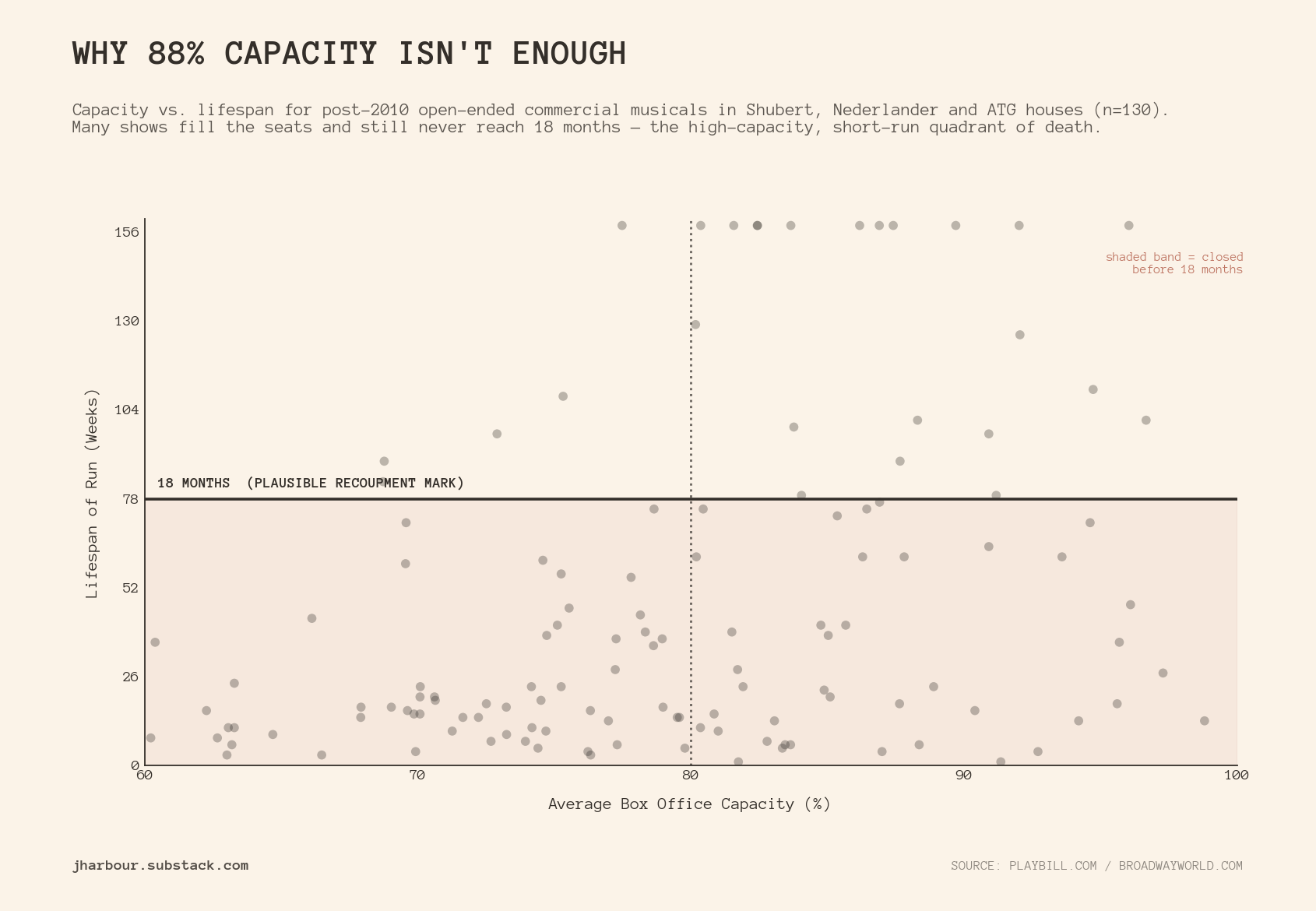
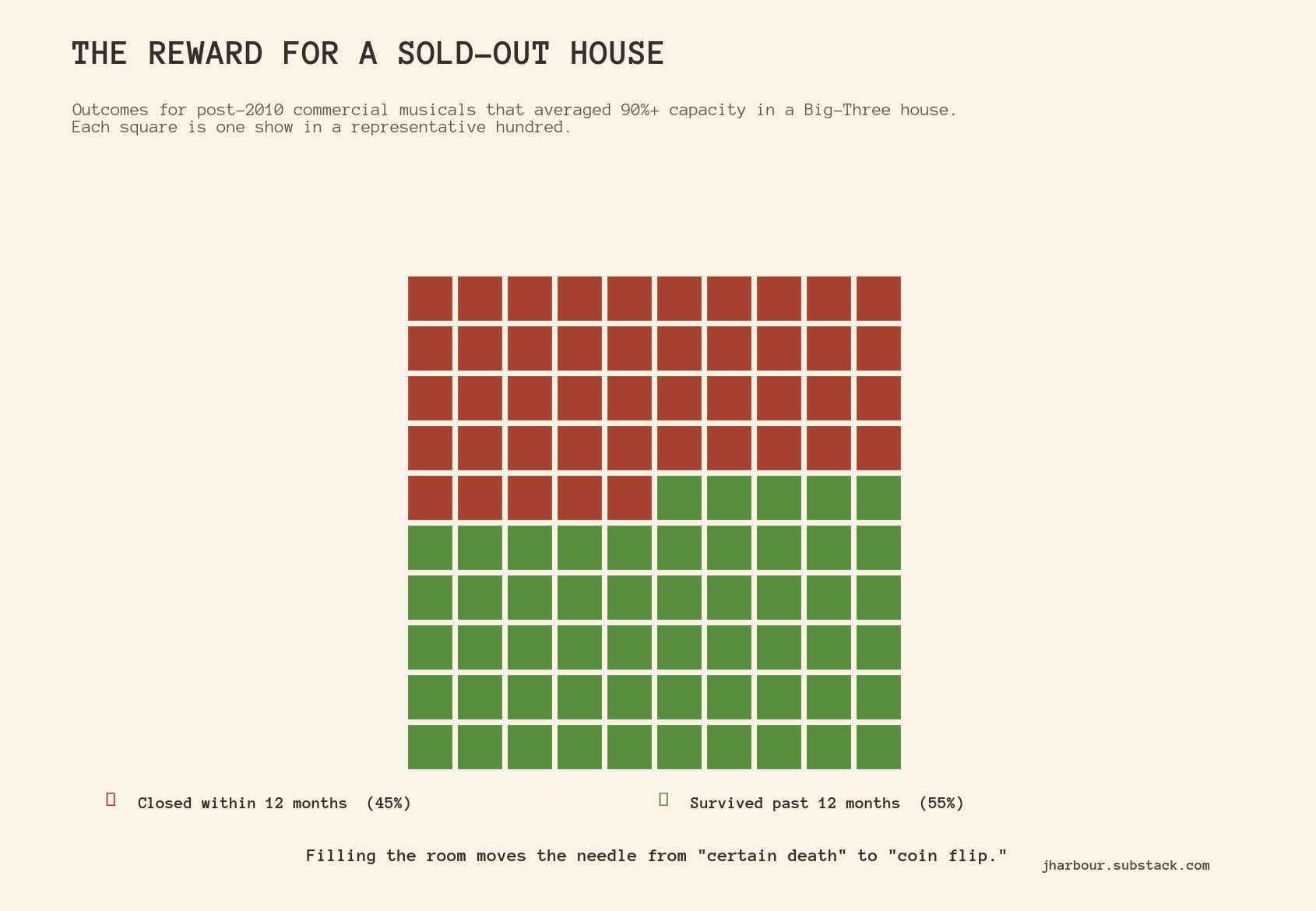
Trace what capacity actually buys you. A show filling under 70% of its seats closes within a year 89% of the time — fine, nobody wants it. Climb to 90%-plus, a house essentially sold out every night, and you still have a 45% chance of being gone inside twelve months. Filling the room moves you from “certain death” to “coin flip.” That is the entire ceiling on how much winning at the box office can save you.
The individual cases are worse than the averages, because you can read the tombstones.
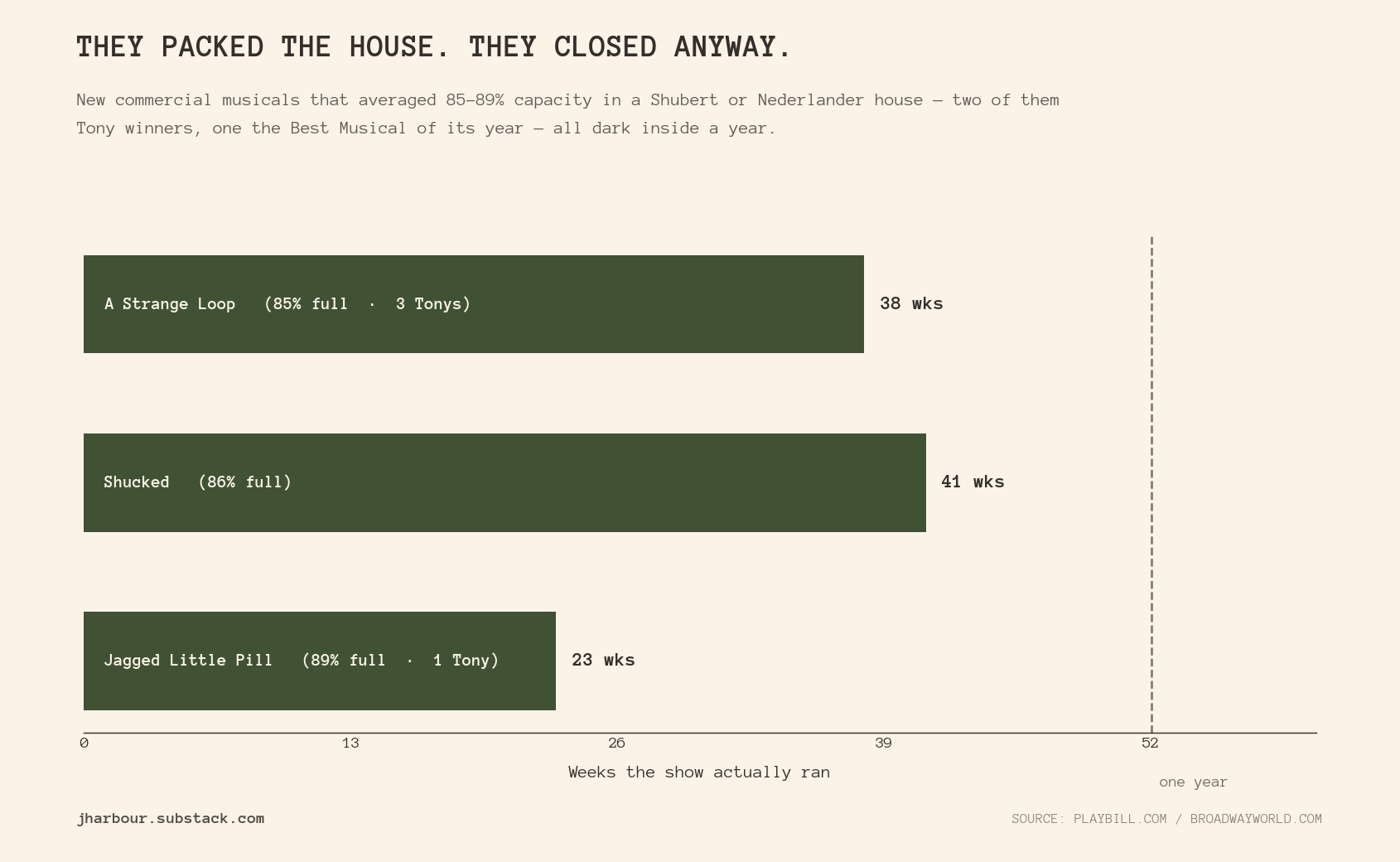
A Strange Loop won the Pulitzer Prize and the Tony for Best Musical, averaged 85% capacity, and closed in thirty-eight weeks.
Jagged Little Pill — a Tony winner, 89% capacity — lasted twenty-three weeks.
Shucked, 86% full, gone in forty-one.
None of these are a flop. A flop plays to an empty room. These played to a nearly full room, collected the highest honors the art form can bestow, and died anyway. If demand were the problem, the sold-out show would be safe. The sold-out show is not safe. Which locates the thing killing these productions squarely on the cost side of the ledger — and the cost side is where the landlord lives.
Pull back to the shows that opened after the industry reopened, and the picture sharpens to a point. Thirty-nine new commercial musicals have opened on Broadway since September 2021. As of this writing, five have recouped: Six, MJ, & Juliet, The Outsiders, and Just in Time. Five out of thirty-nine — roughly one in eight — returned their investors’ money. Every other new commercial musical of the post-pandemic era either lost some of its money, lost all of it, or is still running with the meter against it.
That is not an industry with an audience problem. That is an industry with a math problem.
The wrong show in the wrong room — a conversation at Sardi’s
Cats: The Jellicle Ball was genuinely progressive theatre. Reconceiving that material through ballroom and vogue culture was a real artistic idea, executed by real artists. I saw it downtown at the Perelman Performing Arts Center and thought it was terrific. This is not a piece about a bad show — and the data even places Cats right in the pack described above, an 88%-capacity production that closed inside its first year, sitting on the shelf beside Jagged Little Pill and A Strange Loop. It did the normal thing. That is the entire point.
My argument is narrower and harder to dodge: a spectacular, intimate show built for a 500-seat downtown house should not be forced to bloat its budget, double its ticket price, and fill 1,500 seats simply to feed the Broadway real-estate machine. The problem was never the work. The problem was the room the industry insists every ambitious work must eventually enter, regardless of whether the work was designed for it. Some shows are Off-Broadway shows. Some are PAC shows. Not everything belongs on Forty-Fourth Street, and the refusal to make that distinction is how you manufacture a graveyard of good productions that were simply pointed at the wrong-sized, wrong-priced hole.
I said roughly this to Robert Wankel, who runs the Shubert Organization, when he materialized at my table at Sardi’s a while back. I was at dinner with two producers, Wankel came over to greet them, and I — being constitutionally incapable of watching a conversation happen near me without inserting myself into it, a personality defect I’ve made peace with — jumped in. He asked, pleasantly, whether I was going to see Cats.
I told him no. Not because I doubted the artistry, which I’d already admired downtown, but because I couldn’t justify paying roughly double to watch, in a cavernous house, a piece that had been perfect at intimate scale — and because I suspected a lot of my generation would run the same math. The show didn’t need Broadway. Broadway needed the show, to fill a room and start the meter running. Wankel took it the way you’d expect a man who owns seventeen theatres to take unsolicited box-office analysis from a stranger at a dinner he wasn’t invited to: with a smile, a small laugh through the nose, the kind of pause that isn’t really a pause because nothing you said requires an answer. He didn’t say cute. He didn’t have to. It was in the eyebrows. I could see him filing me under kid who thinks a spreadsheet is a personality, and honestly, fair, that might be a real category I belong to. He moved on to the producers he’d actually come over to talk to. I went back to my martini. Landlords don’t have to win the argument. They own the room the argument is happening in.
Why the landlord is the calmest person in the room
The mechanic under all of it deserves to be built slowly, because it’s the hinge the whole essay swings on.
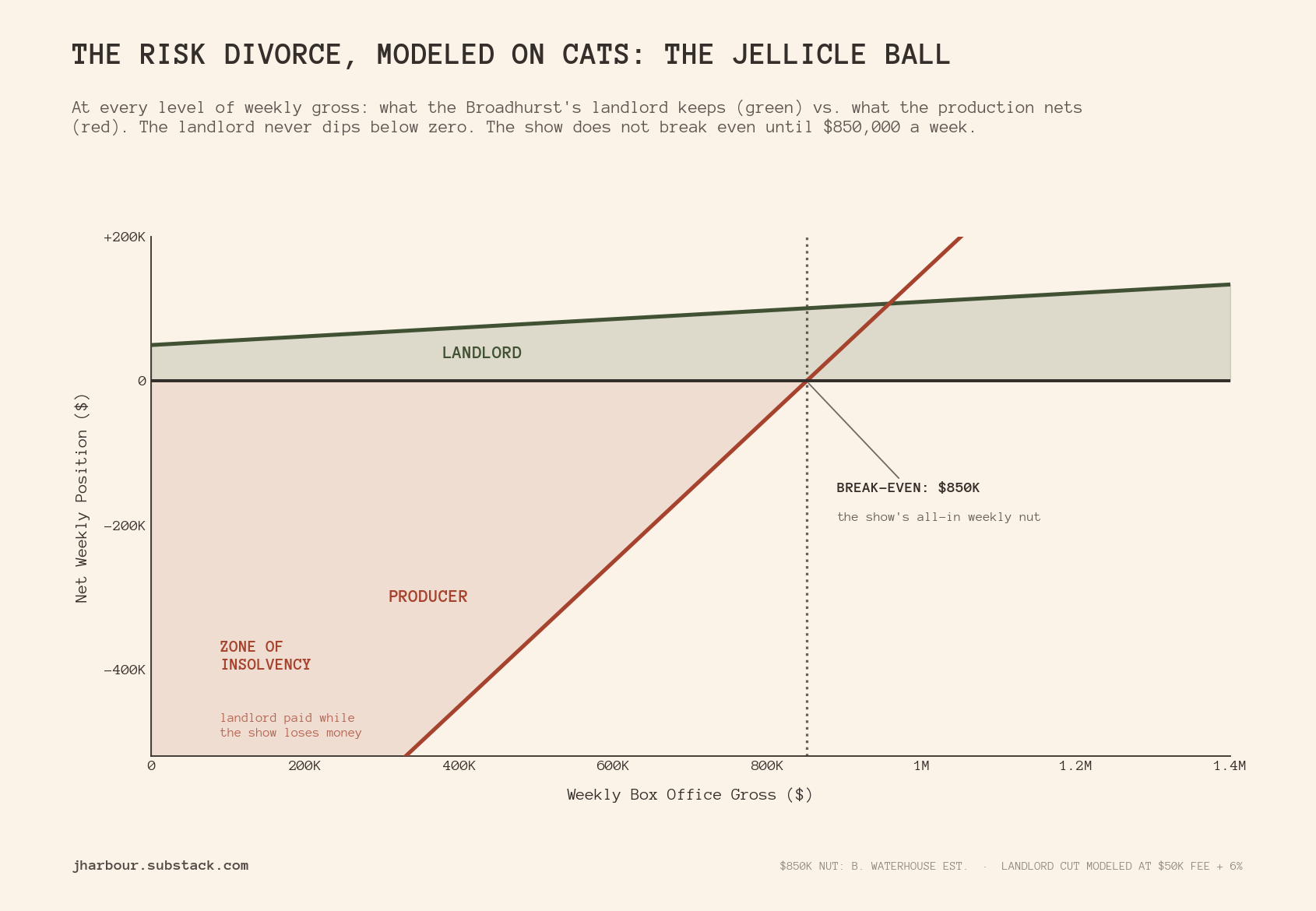
A Broadway theatre owner doesn’t rent you the room for a flat check the way a landlord rents an apartment. The deal has two parts. First, a fixed weekly fee — real rent, low tens of thousands as a base, though once you load in the building’s own HVAC, utilities, insurance, and fixed operating costs it climbs toward fifty or sixty thousand a week before a single usher is paid. That part is fair. The building is real, the roof is real, the landmarked hundred-year-old asset is genuinely expensive to keep standing, and I have zero quarrel with fair rent for it.
The second part is the wound. On top of the fee, the owner takes a percentage of your box office, typically five to seven percent of the gross, from the first dollar. Not the first dollar of profit. The first dollar, period. Before your actors, before your crew, before you’ve recovered a nickel of the cost of running the show that week.
Consider what that does to risk. Monster week: the landlord takes six percent of a monster. Catastrophic week — half-empty house, bleeding cash, closing notice on the callboard: the landlord still takes six percent, off the top, before your costs, guaranteed. He is a partner in your upside and a stranger to your downside. Every other artist attached to a Broadway show — the authors, the director, the designers — long ago converted their deals to take a slice of the profit, earning nothing in a losing week. Two parties never made that trade: the A-list movie star doing a limited run, and the man who owns the building.
That is why the landlord is the calmest person in any Broadway meeting. He has engineered a seat where he cannot have a genuinely bad week as long as the lights are on, and if your show dies, another moves into his room in a few months and pays the identical toll. The production carries all the risk. The landlord carries a clipboard.
The percentage is the tell — and a mall proves it
You might reasonably shrug: lots of landlords take a cut of sales. Every shopping mall in America charges “percentage rent.” Why is Broadway different?
The answer is the most damning number in the business, and it hides in the difference between two leases.
In a mall, percentage rent has a floor called a breakpoint. The landlord collects base rent, and his percentage kicks in only above the point where the store has already covered that rent. Below the breakpoint, he gets his rent and nothing more; he shares the upside only after the tenant is safely in the black. Why so generous? He isn’t generous — he’s afraid. Gouge the shoe store and the shoe store leaves, to the mall across the highway or the strip center down the road or the internet. The breakpoint exists because the tenant has somewhere else to go, and competition forces the landlord to keep skin in the tenant’s survival.
For Broadway, there is no theatre across the highway, no strip center, no internet you can move a Broadway opening onto and still be eligible for a Tony, still get the cast album, still get the touring and licensing afterlife where the real generational money in this industry actually lives. This is especially self-evident when acknowledging the long line of new shows willing, nay, clamoring, to come into an empty theater once the prior tenant has left, leaving the landlord with very little risk regarding an inability to secure a new show in their space.
So Broadway’s landlords simply deleted the breakpoint. They kept the half of the mall lease that pays them and surgically removed the half that protects the tenant — and they can, precisely because the tenant has nowhere else to go.
This is not a story about greed. Greed is boring and universal. This is a story about a broken risk matrix. Functioning capitalism ties reward to risk: the mall owner sets a breakpoint because he is a genuine partner in his tenant’s survival, exposed to the same downside, betting on the same outcome.
The Broadway landlord has severed that link entirely. He collects maximum reward while carrying nearly zero production risk, which is not a landlord’s position at all. It is a tollbooth’s — a fee for passage across the only bridge to the only destination, owned by the people who own the bridge.
Why we sign — and here I indict my own tribe
If the deal is this lopsided, why does any producer sign? “No alternative” is true but incomplete, and the incomplete part is the ugly part.
A lead producer does not carry the investors’ risk. The lead producer typically draws an office fee for running the production, a producer royalty — a slice of the gross, sitting right beside the landlord’s, off the top — and billing: name above the title, Tony eligibility, a credit that follows for life. It is entirely possible, and it happens constantly, for a lead producer to raise eighteen million dollars, open on Broadway, watch every investor get wiped out, and still personally come out ahead, paid to mount the thing. The structure rewards opening a show. It does not reliably reward recouping one. Those are different jobs, and only one is the job the money believes it’s funding.
Then the vanity, which is the fuel the landlords are truly pricing. There is exactly one place on Earth to take a Broadway bow, and producers — I have felt this pull myself — will pay nearly anything for it. The landlords have spent a century watching people torch other people’s money for the prestige of that address. You do not offer your best terms to a counterparty who has publicly proven he’ll pay any price to be in the room. You offer him the worst terms he’ll tolerate, and he tolerates a great deal, because to a certain kind of producer, not producing is worse than losing.
The lease is exploitative because we are exploitable. I’m not letting us off the hook. The honest version holds two truths at once: the landlords built a punishing machine, and producers keep feeding themselves into it with their eyes open.
The part nobody says: the two sides of the table want opposite things
The structural heart of it, and the reason I don’t believe this gets fixed.
Broadway’s producers and Broadway’s landlords negotiate the industry’s union contracts together, as a single employer bloc, through the Broadway League — the trade association both belong to. Efficient on paper. In practice it seats two parties with directly opposed interests on the same side of the table and asks them to speak with one voice, and they do not want the same thing from a labor contract.
The landlord’s entire interest is occupancy. He needs a running show in the room — any running show — because his money comes off the top regardless of whether that show ever recoups. A contract that keeps houses lit and shows technically operating is, from the landlord’s chair, a fine contract, even if its terms make each individual production harder to pay back. Continuity is his product.
The producer’s interest is the precise inverse. He eats the labor costs on a single show and needs them low enough and flexible enough that his one production can clear its nut and return its capital. He doesn’t need the district occupied. He needs his show solvent.
Seat the party indifferent to labor costs and the party crushed by them on the same side, then hand the real leverage to the indifferent party — who also happens to control the only rooms anyone can play — and the contracts drift toward what serves occupancy over what serves solvency. The most powerful voice in the coalition genuinely does not mind if the per-show cost climbs.
I won’t overstate what I can prove. I cannot show you the bargaining transcripts; nobody outside the room can, WHICH IS ITSELF THE SCANDAL. One Redditor put the objection to the old piece precisely: pointing at the League’s board is not the same as showing who sat on the bargaining committee, what positions they took, or which concessions died in the room. He’s right, and I’ll concede it rather than bluff past it. I can’t show you the committee. The contracts aren’t public, the minutes aren’t public, the votes aren’t public. But that concession is the indictment, not the escape hatch. The reason nobody outside can prove who runs the room is that the room is sealed to everyone outside it — the public, the press, and the investors whose capital is on the table.
The opacity isn’t a hole in the argument. It is the argument.
What I can add isn’t a document, it’s testimony. In the past year, more than ten different Broadway League producers have told me the same thing unprompted: outside of David Stone and one or two other mega-producers big enough to cut their own deals, the League is run by the landlords and their agents. No filing verifies that sentence and I can’t link you to it. But it was said to me in near-identical words by the people who sit inside the coalition and pay for it, people whose interest runs the other way, because it’s an admission that their own association isn’t really theirs.
What I can state precisely is that the structure is a textbook conflict of interest: a coalition bargains hardest for its most powerful member, and the most powerful member here — the landlord — holds an interest that is frequently against the producer’s. That isn’t a conspiracy theory. That is how coalitions behave when one member owns the scarce asset.
I am not anti-union. Read that twice.
This next part gets deliberately misread, so let me bolt it down.
Pay the crew. Pay them well. Pay the actors a wage they can raise a family on in the most expensive city in America. Pay the musicians like the world-class artists they are. The people who build and run these shows are the reason the shows are worth seeing, and anyone who reads a cost argument as an argument for underpaying them is either not paying attention or arguing in bad faith. My problem has never been with a human being earning a living.
My problem is with one narrow category: archaic, building-bolted work rules — terms written against the theatre instead of against the production. The cleanest example is the musician minimum. Certain houses carry a contractual minimum number of musicians tied to the building itself, so a show written for a four-piece band can be required to hire and pay a full pit of eighteen, then pay the fourteen it never uses. The industry’s own word for those players is “walkers.” They are paid to not play.
Paying a musician to make music is sacred. Paying a musician not to make music, because a number bolted to a room since the 1960s demands it, is not a wage — it’s a recoupment tax that helps no artist and protects no craft.
Now watch how that rule connects to everything above, because the walker is not a separate problem running in parallel. The walker is a symptom of the landlord’s dominance at the bargaining table.
Recall who negotiates: landlords and producers, one bloc, opposed interests. When the League faces the unions on production costs like these minimums, the landlord’s overriding fear is a dark house — vacancy is the one thing that actually costs him. So the coalition’s most powerful member has every incentive to concede on costs he doesn’t personally pay in order to buy the labor peace that keeps his rooms lit. The landlord trades the producer’s money to purchase the landlord’s peace. The walker survives because the party with the leverage to eliminate him has no reason to, and the party desperate to eliminate him has no leverage.
The one time this dynamic broke into public view was 2003, and the record is unambiguous. The League (landlords very much included) pushed to slash orchestra minimums from 24–26 players down to as low as 7, even threatening to replace live musicians with a “virtual orchestra.” Local 802 struck. Actors and stagehands refused to cross. Eighteen musicals went dark. And within four days — after the city pegged the losses at ten million dollars a weekend — the parties were hauled to Gracie Mansion at Mayor Bloomberg’s insistence and settled at 18–19, locked for ten years. The employer bloc had the appetite to gut the minimums and the leverage to try, and folded almost immediately, because the thing it could not stomach was a prolonged dark house.
Vacancy set the ceiling on how hard they’d fight.
That is the mechanic, on the public record, in the one instance we’re permitted to see.
What would be different on Tuesday — and why it won’t happen
The fixes are simple to describe and, I’ll argue, nearly impossible to enact — and the reason they’re impossible is the same reason they’re needed.
Split the bargaining association. Landlords and producers should not negotiate the unions as one voice. Producers should bargain, and ratify, the contracts producers actually pay for.
The hole in that, which I’ll name before you find it: producers bargaining alone have almost no leverage against the unions. Local One, Local 802, and Equity are disciplined, permanent, unafraid. A transient producer holding an eighteen-million-dollar bag folds before he eats a strike, every time, because nineteen dark days destroys him while the union holds a strike fund and a century of patience. Splitting the vote yields a weaker employer, not a fairer contract. Necessary, nowhere near sufficient. The leverage has to come from elsewhere.
It comes from transparency, aimed like a weapon — and I can tell you exactly whose hand should throw it.
The reflexive objection is that all of this is already disclosed: investors sign offering documents, they know what they buy. Untrue, and I know it from direct experience. Investors see a top-line budget — a number for “theatre,” a number for “crew,” a number for “music.” They never see the machinery beneath: the collective bargaining agreements that dictate why the music number can’t move, why a house minimum mandates fourteen walkers, why the theatre number is non-negotiable. Those agreements are not public. You cannot read the AEA, Local One, or 802 contracts online. You can generally only obtain them as a Broadway League member — I have personally had to ask colleagues to send me updated copies of contracts governing millions of dollars of other people’s money, because there exists no public place to simply read them.
That opacity is the load-bearing wall. So knock it down, and be specific about who swings the hammer, because “someone should publish the contracts” is a wish, not a plan. The League won’t publish them. The unions won’t. But two groups hold real pens.
Lead producers: if you actually respect the people funding you, leak the CBAs to your investor pool. Put the machinery in front of the money that’s exposed to it.
Investors: before you wire the eighteen million, demand the house-charge schedules and the relevant contract terms in writing. Make disclosure a condition of the check. You have the one form of leverage no producer possesses — the leverage of not funding — and you are currently declining to use it because nobody has shown you the page worth objecting to.
The instant serious money can read how systematically its equity is subordinated — to hidden inflexible minimums and a first-dollar landlord cut and a percentage that keeps taking through the losing weeks — it does the one thing that has ever reformed this industry. It stops writing checks until the terms change.
The threat that fixes Broadway is not a work stoppage. It’s the eighteen-million-dollar checks drying up.
Put a breakpoint back on the percentage. Keep the fixed fee whole and senior — pay it in the dark weeks, the building is real. But let the percentage trigger only above the show’s weekly operating floor, exactly as every retail lease in America already does. If the landlords respond by raising the fixed fee to stay whole, fine — do it, and put the number on the page where a producer can read it, price it, and refuse it. A rent you can see is a rent you can fight. The whole arrangement depends on the second rent being invisible.
The honest ending: none of this is likely, and the reason is welded into the problem. Producers cannot demand these changes, because the party they’d demand them from is the same party who decides whether they ever get a theatre again. The relationship is too intimate, too repeated, too lopsided — forty-one rooms and one of you against hundreds of you and one landlord. You do not spend your leverage, you do not even betray that you hold opinions, with the man who controls whether your next show has a home. The scarcity that creates the problem is the same scarcity that enforces the silence around it.
Forty more years
The man on LinkedIn thinks I’m a doomsayer because I keep publishing the burn rate. But a doomsayer is invested in the ending. I’m invested in the beam.
You don’t read the inspection report on a building you want to see fall. You read it because people are living inside, and you love them, and you can see the load the beam was never built to carry. I plan to be in this building for forty more years. I think a room full of strangers agreeing to become a temporary community in the dark for two hours is close to the most valuable thing we make as a species, and I think it’s worth the deeply unglamorous labor of reading the contracts nobody will publish and running the arithmetic nobody wants run.
So to the nice man in my inbox: I’m not your doomsayer. I’m the guy standing in the smoke with the blueprints, pointing at the one beam, asking the only question that matters — not whether the building falls, but whether anyone with a key is going to walk over here and help me fix it first.
A minor point of clarification on musician minimums: since the '90s, the contracts include a "special situations" clause where a show can argue that the artistic vision of the show necessitates a smaller orchestra than the theater requires. i.e. if "Rock of Ages" is going into a house with a 15 musician minimum, the producers can make a case that this is clearly a show built for a 5-piece rock band, and there is a procedure for the producers and musicians union to evaluate whether that's a legitimate request. These are pretty common and it seems the reduction is often accepted ("Here Lies Love" being a recent example where the case for a special situation was rejected). In part because of this, my (limited) understanding is that the practice of paying "walkers" is basically extinct in Broadway.
Really appreciate your thoughts and analysis- just wanted to offer this clarification on behalf of pit musicians.
Did you mean the following description in general, or about CATS: TJB specifically:
"a spectacular, intimate show built for a 500-seat downtown house should not be forced to bloat its budget, double its ticket price, and fill 1,500 seats simply to feed the Broadway real-estate machine."
CTJB combined the two largest venues at PAC for a capacity of at least 700 (likely more, but I can't find an exact number online) and the Broadhurst had a capacity of 1,160 for the run. So an increase of approx. 40%, not 300%.
And the run at the PAC had tickets ranging from $68-$309, similar to their Broadway prices.
Which I think makes more of a case for a bloated budget than anything else, so my question, would CTJB have been better off, fiscally, by staying at the PAC?