Fake Money
A second straight “record” box office. Also one of the most creatively threadbare seasons in years. Guess which one made the press release.

Every spring Broadway mounts one production that never closes, never recasts, and never loses a dollar: the announcement that it has just had the best year of its life. The run is short, a single press release in the last week of May, but the reviews are unanimous and the house is always full. This year’s edition opened on schedule, to raves. Highest-grossing season in history. A record, for the second year running. Broadway’s back, baby!!!
I believed it for about as long as it took me to finish reading it, which was maybe thirty seconds into my morning before I’d had coffee or done anything that could reasonably be called thinking, and even then it didn’t hold, because the arithmetic says the thing the announcement is built to keep you from saying, and the thing it says is that the record is fucking fake.
It was, for the record, a very weak season artistically speaking, and I haven’t heard many people in and around the industry even try to pretend otherwise. A slate propped up by jukebox cash-ins, movies photocopied onto a stage, revivals hauled out for a third turn, and famous faces flown in to move a weekend of tickets. Strip out the brand names and the stunt casting, and there was alarmingly little left to argue that this art form still earns the room it takes up.
A weak year crowned the richest in history.
Total gross: $1.91 billion across fifty-two weeks, a record, the second running. It’s a real figure… and its real meaning is absolute horseshit, because gross is just attendance and price multiplied together and then counted in whatever the dollar happened to be worth that year. Since 2018 the dollar has shed about a third of its value. Announcing a “record gross” in 2026 is like bragging that your paycheck has more digits than your grandfather’s.
There’s a better number, and it isn’t a secret. Hotels gave up bragging about total revenue decades ago in favor of revenue per available room, because that one figure carries price, occupancy, and the size of the building inside it, and it can’t be gamed by adding rooms or by a softening dollar. Broadway owns the same instrument and almost never picks it up. Take the gross, drag every dollar into the same year’s money, and divide by every seat the industry actually put up for sale. What does one seat earn. Ask that, and the champagne goes flat.
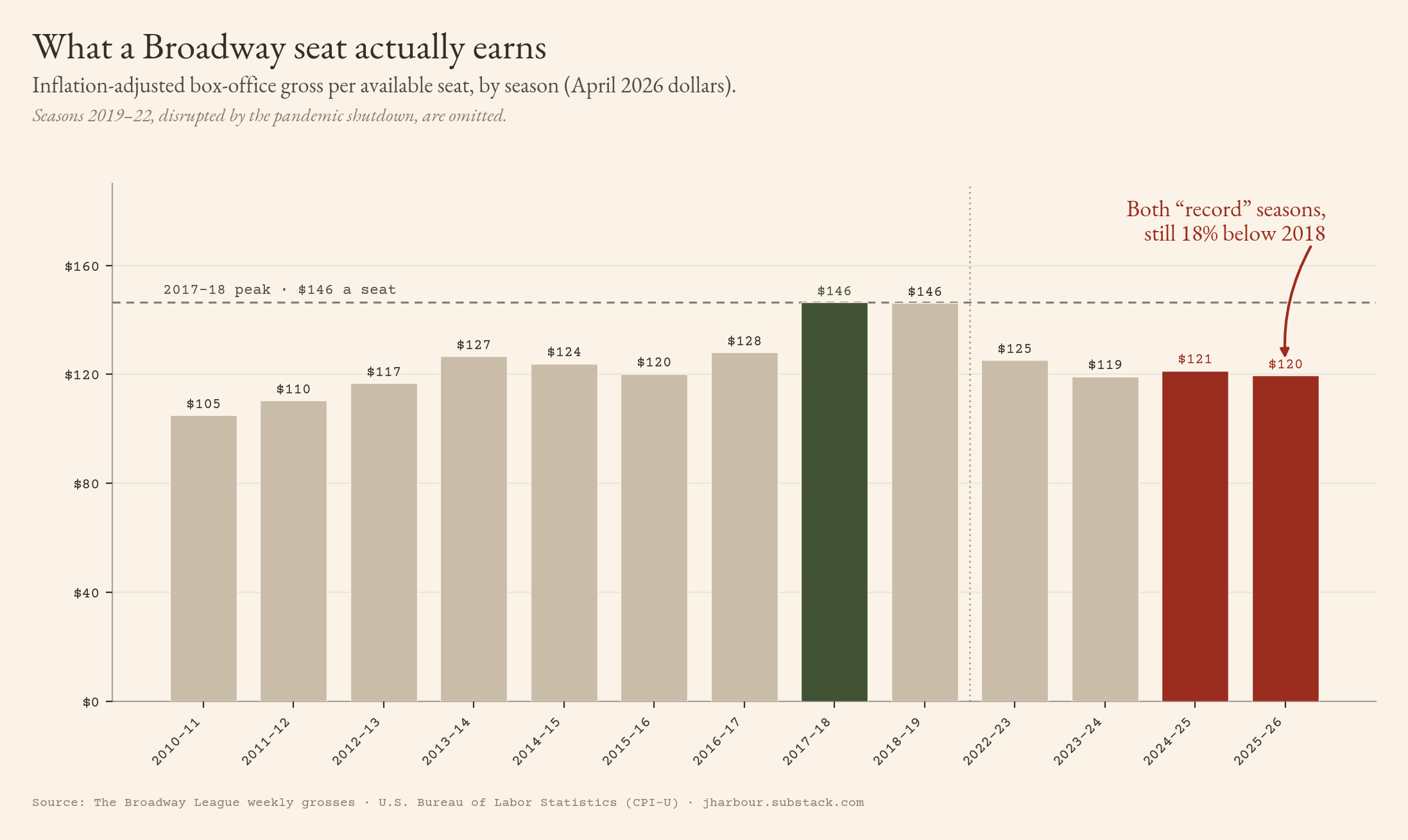
$146 at the 2017–18 peak, in today’s money. $120 this year. The two “record” seasons sit down in the rubble with the worst of the post-pandemic wreckage, a fifth below where the seat was before any of this started. The 2025–26 “record” earns less per seat than the 2024–25 “record,” which itself barely cleared the lowest year of the whole recovery. Call it a climb if you want. It looks more like a long, well-lit sit on the floor, narrated from above as an ascent.
Stretch it across seventeen years and the shape stops being arguable.
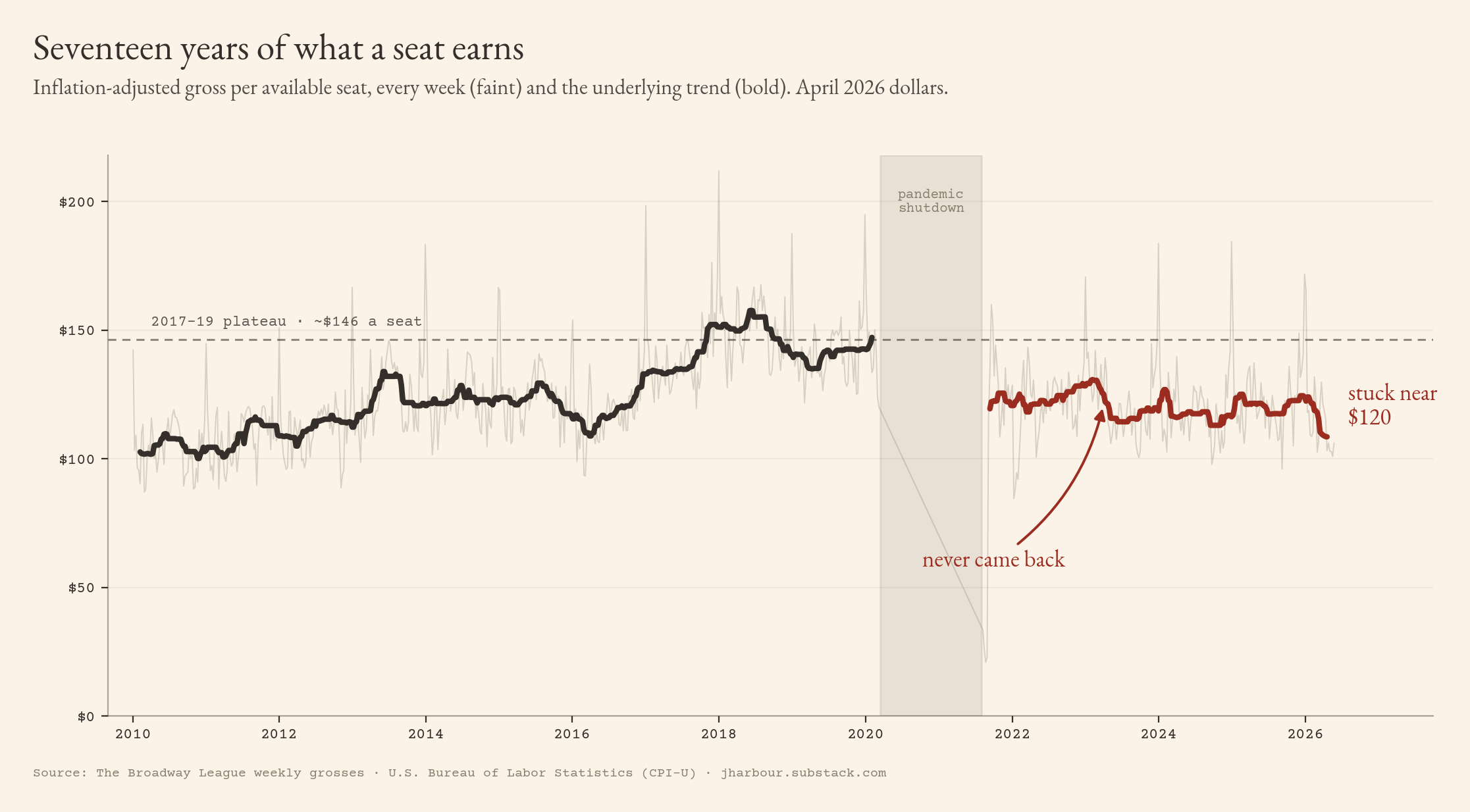
Three full seasons open, audiences back, and the seat earns what it earned in 2011. The shutdown explains the crater, but sadly, cannot explain the shelf.
What turns this from a measurement problem into something that actually pisses me off is that the honest number costs nothing to make. The grosses are theirs. The attendance is theirs. The inflation figures sit on a federal website, free. The real math takes ten minutes. It goes unrun because it won’t say “record,” and “record” books the press, and every May the Broadway League hands the trades the flattering version pre-written, a goddamn press kit dressed up as journalism, which is what it has quietly (or not really quietly at all) become.
Put the two numbers side by side.
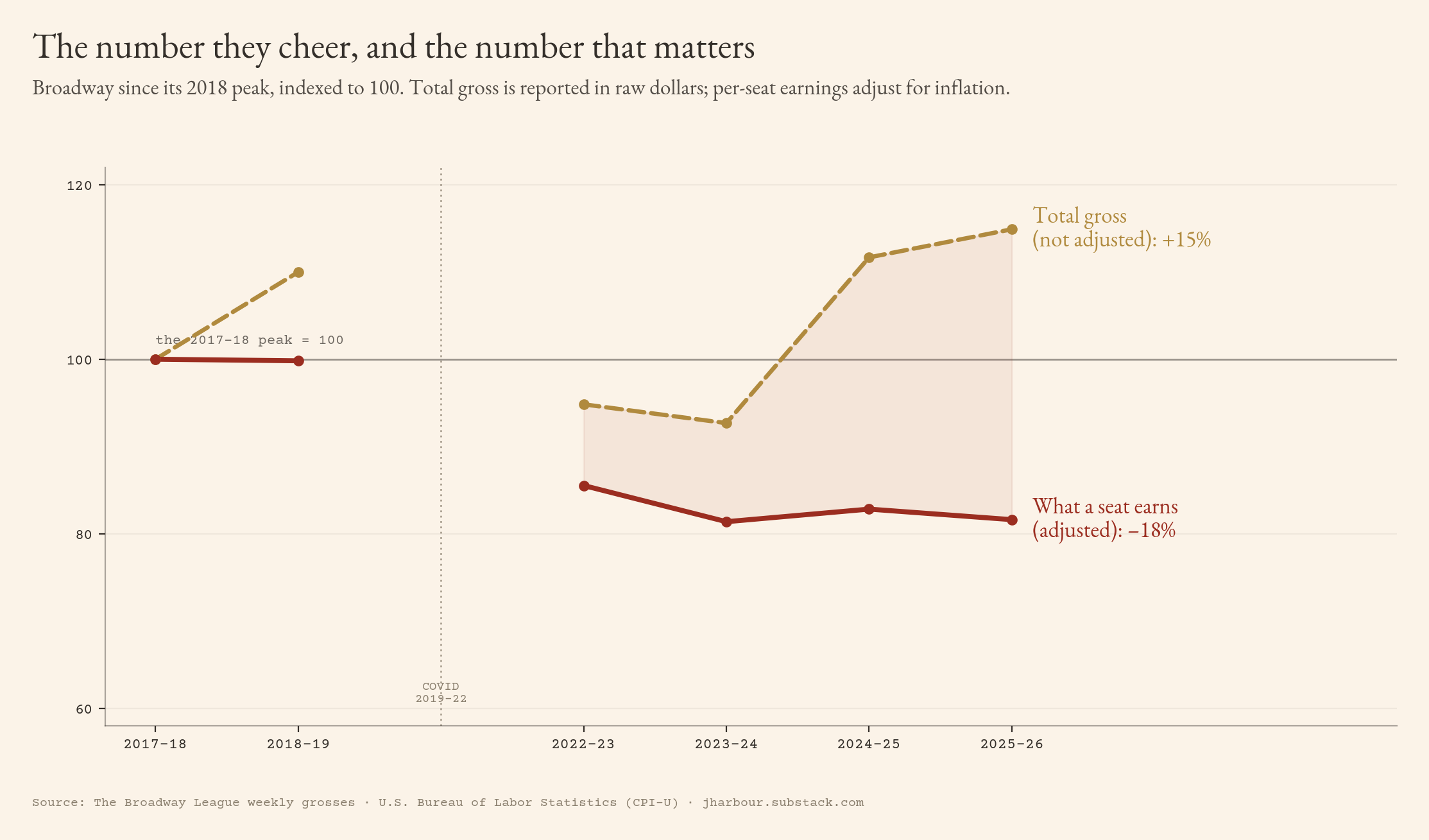
Since 2018, gross is up fifteen percent and turns into a headline. Per-seat earnings are down eighteen and turn into nothing, because nobody prints a decline. The gap between those two lines is the exact volume of bullshit that inflation lets this business launder into good news, on schedule, every spring.
The defenses come reflexively. More shows. More performances. Ninety percent capacity. Fine, and beside the point. More productions are carving up a pie that hasn’t grown in real terms since before the pandemic, so each one eats thinner. And ninety percent capacity is a magic trick, padded with papered houses and TKTS discounts and every comp the marketing office could dump to keep a Tuesday from looking like a wake. A full house at a price that doesn’t cover the weekly nut still bleeds cash. It just bleeds with the lights up.
You don’t have to take the indictment from me. Take it from the house. Announcing last year’s “record,” the president of the Broadway League said the industry has to be “sober about the challenges” it faces and “can’t be satisfied with 2019’s definition of success anymore.” The guy holding the trophy, on the record, telling the room the trophy is fake. The trades ran the trophy photo anyway.
And that is the rot under the ritual. The “record” is permission to stop looking, stop investigating, stop asking ourselves if this is really the best representation of theater we have to offer. It lets a hollow season pass for a triumph and lets a sinking yield vanish under a taller pile of softer dollars, the same sickness read off two different charts: a business straining at the box office and on the stage at once, reaching every spring for the one word that spares everyone from having to say so. Everybody in the room can feel it. The League can feel it; its own president said it out loud. And every spring the answer is the same fucking banner, raised over the same denial…. hip hip hooray!
Run that play long enough and you can see where it ends. The smart money learns the trick first (the investors who can actually read a cap table) - they stop picking up the phone, which leaves the business raising its next decade off people who haven’t done the math yet. The work follows the money down. When the safe bet keeps getting crowned, nobody bankrolls the original thing the form needs to stay alive, the pipeline of new writers and new shapes thins toward nothing, and the marquees fill with logos. The audience, told for years that the golden age is right now, walks into one too many competent, unnecessary evenings and quietly decides the whole thing is fugaze bullshit. Nothing about it will look like a collapse while it’s happening. It seeps in slowly, year by year, dressed every May as a celebration, until the distance between the story and the books grows too wide to paper over, and a decade of refusing to look comes due all at once.
So here’s the challenge, to the League and the trades and everyone who reprints the banner. Retire the number that can’t fail, and publish the one that can. Inflation-adjusted gross per available seat is the only figure on Broadway a weak dollar can’t pad, that more theaters can’t dilute, that a stack of comps can’t dress up. It says what the work is worth in money that holds still, and right now it says the work is worth a fifth less than it was in 2018. Nothing gets fixed before that sentence gets said out loud. You cannot repair what you refuse to name, and Broadway has spent two springs refusing to name it.
The seat earned a hundred and forty-six dollars once. It earns a hundred and twenty now. We’ve thrown it two parties for the trouble. The least Broadway could do, before the next banner goes up, is stop lying to itself about how it’s doing, and get to fucking work.