Did We Get the Times?
What 542 shows and a 78% statistical drop reveal about the slow death of Broadway’s most coveted badge.

On December 9, 2025, the cast of The Queen of Versailles gathered backstage at the St. James and was handed a memo. The musical had opened just one month earlier with a New York Times Critics Pick from Laura Collins-Hughes. It had already announced a January 4 closing date. Now, two weeks of advance sales later, the producers (Bill Damaschke, Seaview, Sonia Friedman, and Kristin Chenoweth herself) were pulling the closing forward two more weeks, to December 21. Deadline got the memo. It contained the most unintentionally honest sentence anyone in Broadway has put on paper since 2020:
“Unfortunately, the harsh economic realities of new Broadway musicals in a post-COVID landscape have caught up with us. The industry as a whole is no longer seeing the audience behaviors we’ve relied on to shape our strategies for decades.”
The show was capitalized at $22.5 million. Stephen Schwartz wrote the score, his first original Broadway score since Wicked. Kristin Chenoweth was in the lead. F. Murray Abraham was across from her. Michael Arden was directing, fresh off his Tony for Maybe Happy Ending. The cast wore over a thousand costumes designed by Christian Cowan. And in the lobby, the closing-week lobby of a show being killed in real time, the Critics Pick badge was still pinned to the marquee like a war medal nobody had remembered to remove.
The Times’ own closing coverage wrote that Versailles “aspired to be a cautionary tale about consumption and greed. Instead, it wound up as a cautionary tale about Broadway.”
The badge doesn’t save you when the audience has already decided. The absence of the badge doesn’t kill you when the audience shows up anyway. And the industry has been ignoring the data saying so for at least two years.
The 78% Warning Sign
To test this, I built a dataset of 542 Broadway shows running from 1988 through May 2026: every review I could find from every publication that covers a Broadway opening (using mainly Didtheylikeit.com #thanksmike), every weekly box-office gross from BroadwayWorld and IBDB, every Tony nomination, and every Critics’ Pick (“CP”) the Times has handed out since 2014. For the CP analysis specifically, I matched each CP show against comparable non-CP shows opening in the same era, controlling for show type (play vs. musical), opening-week sales (so a $1M-opening show is compared to other $1M-opening shows), and how many critics reviewed it. The dataset tries to answer the question: holding everything else equal, what did the Critics Pick badge actually deliver?1
The result comes out as a multiplier on the first two months of grosses. A multiplier of 1.4× means a CP show out-earned its comparable non-CP twin by 40% in that post-opening window. A multiplier of 1.0× means the badge made no difference. A multiplier below 1.0× means CP shows did worse than comparable non-CP shows.
From 2015 through 2018, the multiplier sat between 1.2× and 1.5×. The badge was worth, on average, an extra 20–50% in post-opening grosses.
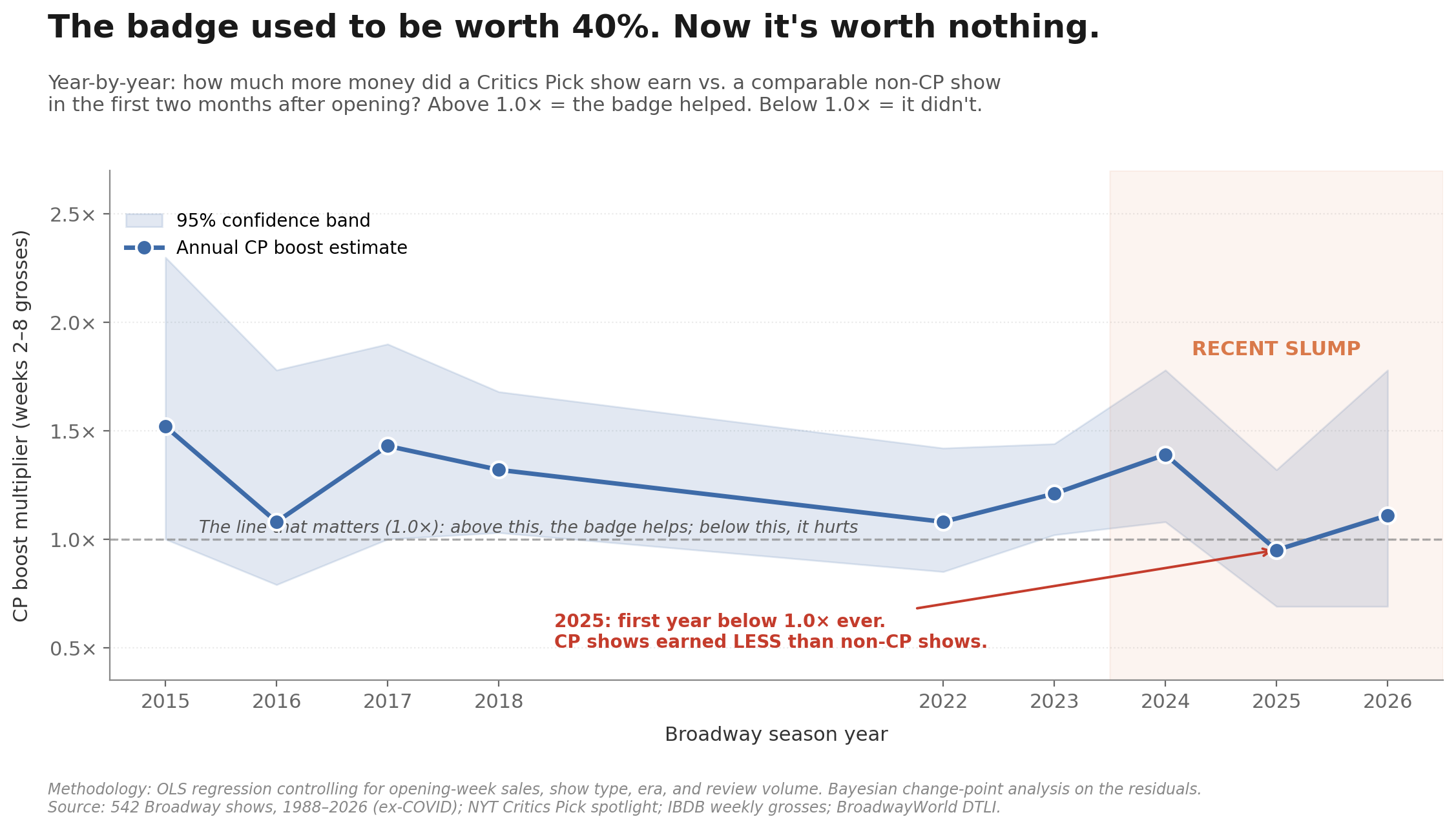
By 2022 the multiplier was 1.08×. By 2024 it had recovered to 1.39×, which looked encouraging. Then 2025 happened.
The 2025 multiplier is 0.95×. For the first time in the entire eleven-year series, the badge correlated with weaker post-opening sales rather than stronger.
But a single bad year can be a hiccup. The Critics Pick badge has only ever attached to twelve to fourteen shows per season, which is a small sample, and small samples can produce a low outlier by chance. To check whether 2025 was a fluke, I ran what’s called a Bayesian change-point analysis on the eleven-year series. The technique works roughly like a careful version of “given everything we’ve seen across all eleven years, what’s the probability the relationship between CP and box-office has genuinely shifted, and if so, when?” The answer is 78% probability of a real structural decline, with the most likely breakpoint being 2024.
Translated into plain English: there’s roughly a 4/5 chance the badge’s commercial sauce has genuinely weakened, and a 1/5 chance the last two seasons are a statistical mirage that will revert. Four-in-five is the kind of number you should not be ignoring when you’re betting $22.5 million dollars on the bet going the other way.
That 78% probability isn’t just a number on a spreadsheet. In the 2024–25 season, it looked like three specific, high-profile casualties.
The Season That Broke the Formula
Each of these three musicals opened to a Critics Pick from the New York Times. Each closed inside fourteen weeks. None recouped:
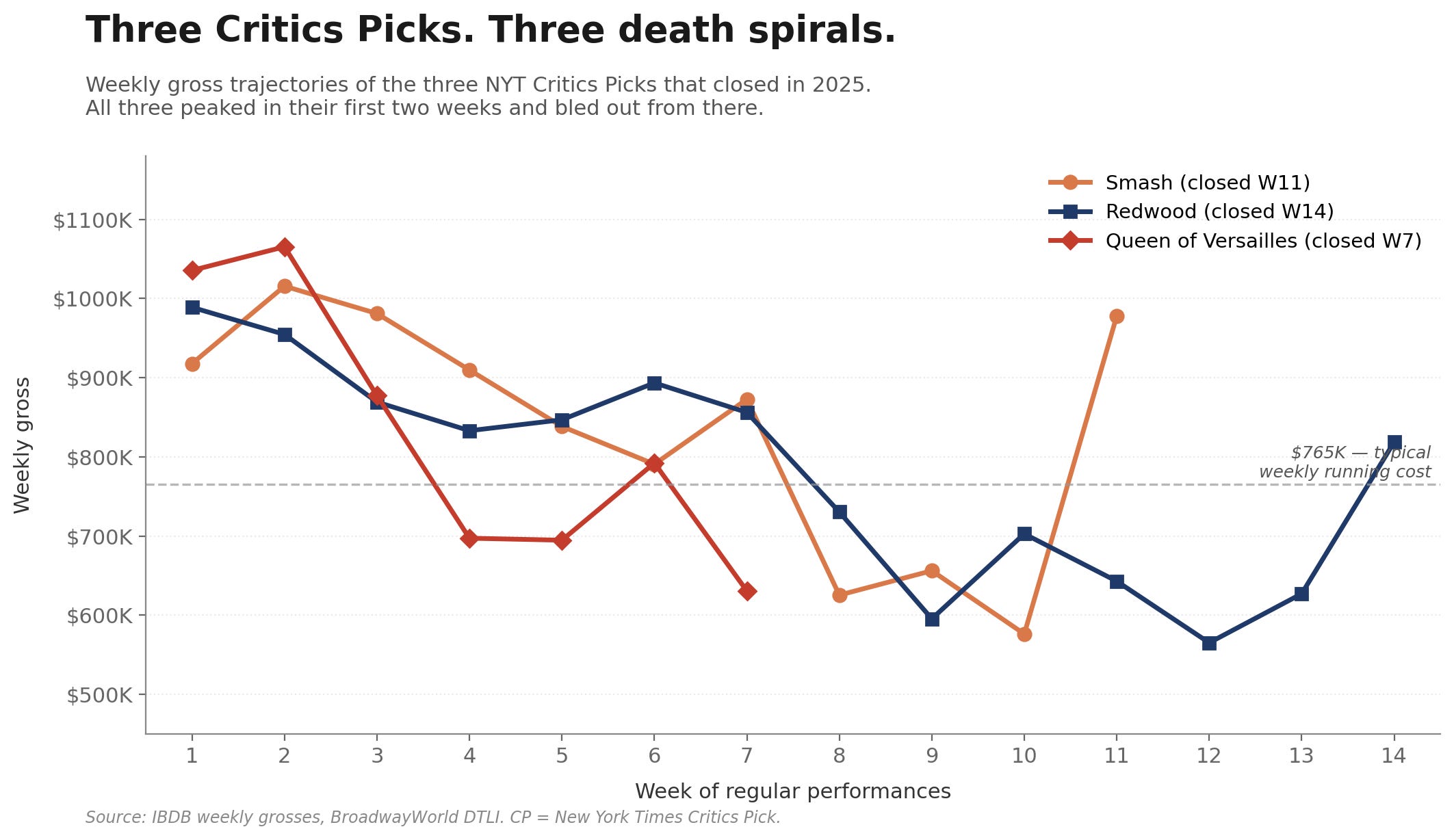
Three Critics Picks. Three peak-to-trough collapses of roughly 40%. Three closings within fourteen weeks of opening. Smash had Spielberg and Stroman. Redwood had Idina Menzel returning to the Nederlander she opened in Rent at. Versailles had Schwartz and Chenoweth. Each one checked every box of the 2010s playbook (star power, name IP, NYT badge) and each one cratered before its third month. The badge was on the wall the entire time. The badge did nothing.
It’s worth pausing on the Smash failure for a moment, because Smash is the cleanest test of a question producers do not want to think clearly about. Smash had the biggest IP advantage of the three shows. It was the stage adaptation of an NBC musical drama series with a devoted cult fan base who had spent thirteen years insisting the show was secretly great. That fan base watched the original air on prime-time television. They wrote think-pieces. They campaigned for a Broadway version on social media for over a decade. When the Broadway version was finally announced, the press release wrote itself. The show closed in eleven weeks anyway.
IP gives you name recognition. It does not give you the kind of fans who cry in the bathroom of the Belasco and post about it. Smash had millions of people who recognized the title and very few who needed to see it. Recognition and earned community are different commercial assets, and the data says only one of them moves second-month grosses now. Versailles had similar dynamics (Lauren Greenfield’s documentary had won at Sundance in 2012; Stephen Schwartz had Wicked). It didn’t matter. The pre-existing awareness was not the same thing as the pre-existing audience, and only the audience was actually going to buy a ticket twice.
The 2024–25 season also produced a useful control case for the theory that critic positioning is what broke.
Tammy Faye opened November 14, 2024. Elton John score. Jake Shears lyrics. James Graham book. Capitalized at $25 million. It did not get a Critics Pick. It did not get broad critical love either; the New York Post called it a “disaster of biblical proportions.” The show closed December 8, 2024, after 29 regular performances and $1.3 million in grosses. All $25 million in capitalization, gone.
Elton John later told the Sunday Times the show failed because it was “too political for America.” The data supports something colder. Tammy Faye did not get the badge, did not get the consensus, did not get the audience. None of those three things saved it. None of them killed it either. The audience simply did not show up.
Smash had everything the playbook required and died. Tammy Faye had none of it and died the same way.
The Paper Closed Its Own Case
In July 2025, three weeks after the Tony Awards, NYT culture editor Sia Michel sent a memo to staff reassigning four senior critics across TV, music, classical, and theater from their reviewing posts. Jesse Green, the man who had given Critics Picks to Smash and Redwood months earlier, became a “culture correspondent.” Michel’s memo explicitly framed the move as a strategic reset: the paper wanted critics who could write “essays, new story forms, videos and experimentation with other platforms.” Helen Shaw, formerly of The New Yorker and New York magazine, was hired as chief theater critic that December.
The reassignment was not, on its face, about Smash or Redwood. The Times does not publicly fire critics over individual bad picks, and four critics across four departments did not get moved because one of them liked the wrong musical. The reassignment was about something larger, and the memo as much as said so: the old format of the chief critic delivering a verdict that the industry then transmits to ticket buyers is something even the Times no longer fully believes in.
The paper of record conducted an internal audit of its own product and reached the same conclusion the regression reached. Helen Shaw inherits a chief critic’s chair that is, by the Times’ own admission, a different chair, some may say a less powerful chair, than the one Ben Brantley or Frank Rich sat in.
What’s Actually Working
The same season that produced the three flops also produced shows that broke through under the new conditions. The most useful one is also the smallest one.
Operation Mincemeat is a five-person British musical with no household names, a property that won the Olivier in London but had zero American press infrastructure behind it. NYT review from Jesse Green: “meh.” No Critics Pick. Of the fifteen critics from other publications in my dataset who covered the opening, twelve voted up, two negative, only the Times and Time Out lukewarm. The show became Entertainment Weekly’s number-one Broadway show of 2025, scored four Tony nominations including Best Musical, and is still running.
Mincemeat has zero of the things Smash had. No NBC fan base, no Spielberg, no Stroman, no IP a producer could write into a deck. It has the opposite asset, which is a cast of five performers who treat the show like the most important thing in their lives and post about it accordingly. There are five people in a basement on TikTok making the joke at the start of “Born to Lead” four times a week and getting forty million views for it. The audience that shows up at the Golden is not there because the Times told them to come. They are there because someone they follow online won’t shut up about it.
Then there’s the most instructive case of the season.
Maybe Happy Ending, a Korean musical about two helper-bots by Will Aronson and Hue Park, opened November 12, 2024 at the Belasco. It got the Critics Pick from Jesse Green. It got, in fact, unanimous positive reviews across the entire critical press corps. It eventually won six Tony Awards including Best Musical.
It also opened bleeding out.
Week 1 of Maybe Happy Ending grossed $458,827. The weekly running cost was approximately $765,000. The show was losing roughly $300K a week the moment it opened. Investors had already pulled out before previews after a TikTok influencer speculated the show would close early. The producers had to scramble to raise the full $16M capitalization in the days before opening night. By the time the reviews dropped, unanimous raves and Critics Pick included, the show was still grossing below its running costs.
What saved Maybe Happy Ending was not the badge. The producers raised an additional $1.75 million in marketing funds, deployed to paid social, while a slowly-building TikTok contingent of audience members posted tearful exit-of-the-theater videos that other people forwarded to other people. It took seven weeks to break $1 million in a single week. By week eighteen the show hit 100% capacity for the first time. It peaked at $1.57M in week 42, riding Tony momentum that was itself riding social momentum that had been building underneath it for five months.
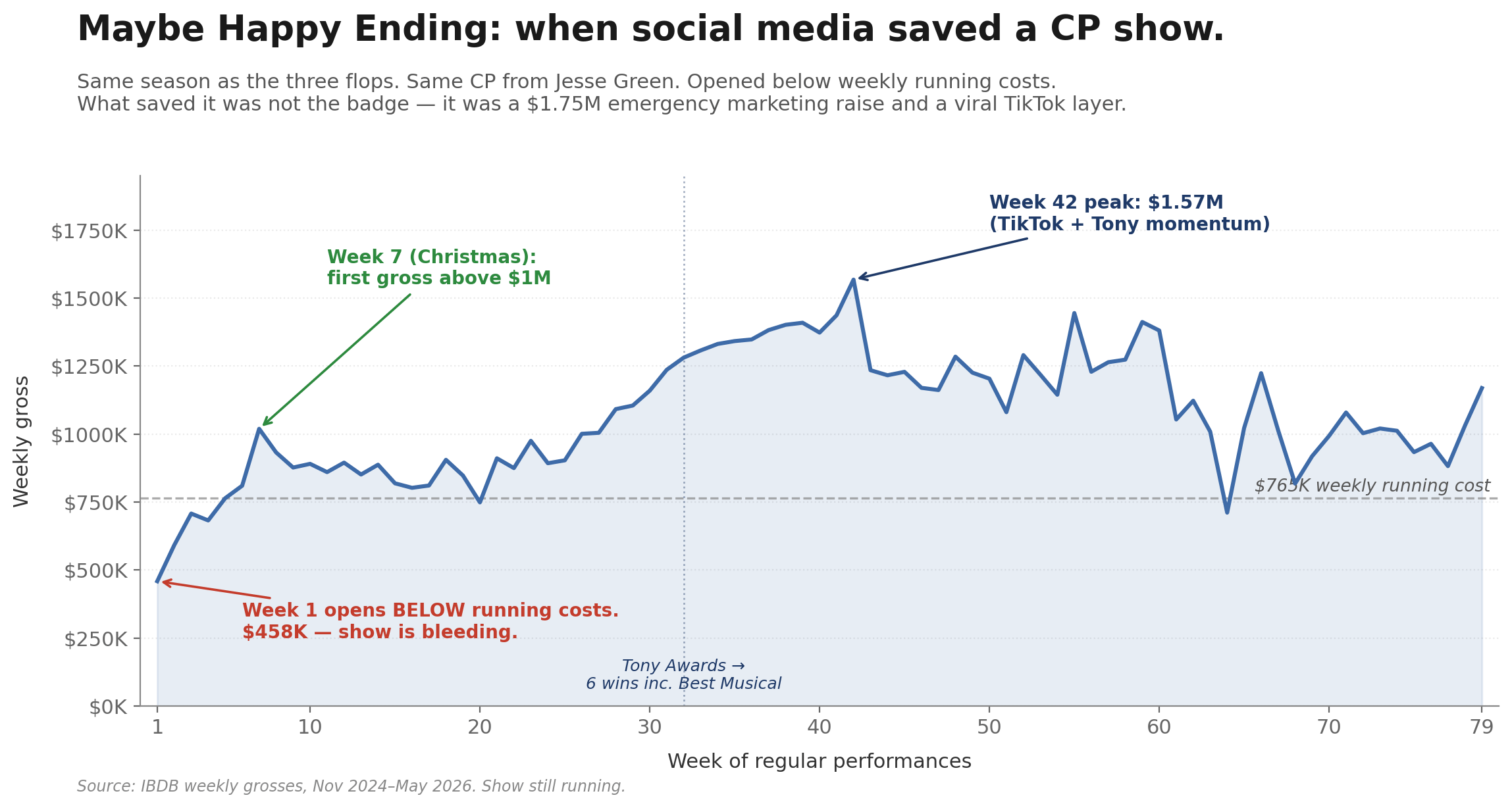
The Critics Pick was on the wall the entire time the show was bleeding out. The cash injection and the TikTokers saved it.
Marketing in the Dark
There is a temptation to read the MHE comeback as a story about ad money. It isn’t, or rather, it isn’t only. The $1.75 million in emergency marketing funds bought paid social impressions. But what those impressions did was put a piece of content in front of an audience that responded the way audiences respond to art: by getting parasocially attached, going home and posting something that started with “okay you guys I just saw the most beautiful thing.” The layer underneath the paid spend was earned. The paid spend bought fuel for a fire the show itself had to be capable of starting.
Paid reach and earned obsession are different things, and they require different infrastructure.
The paid layer is the easy part. Paid TikTok Search Ads, paid Meta campaigns, paid creator partnerships. These are direct-response marketing. You set up UTM-tagged links, you run holdout tests, you measure conversion. SINE Digital ran exactly this kind of campaign for Romeo+Juliet last season and got 14% of the audience in the 18-to-24 age bracket, compared to the Broadway industry average of 3%. Any CFO can be shown the receipts.
The earned layer is harder and more important. The “Crying-in-the-Belasco-bathroom videos”. None of this is paid, nor can it be triggered with a campaign. It happens when the show itself gives an audience something to be obsessed with, and a community forms around that obsession.
The problem is that the earned layer is the part the spreadsheets cannot see.
The Times was easy to track: a review dropped, weekend sales spiked, and producers could point to an arrow on a chart for their investors. The evidence felt clean, even when the attribution was wrong.
TikTok organic is dark. A fan sees a video Tuesday, mentions it to a friend at brunch Saturday, the friend’s roommate buys a ticket Thursday night. The producer’s dashboard logs that ticket as “direct traffic / unknown source.” There is no arrow to draw. The CFO sees a $1.2M paid TikTok line-item and a sales report that does not credit it. The pressure to cut the spend and reallocate to channels with cleaner attribution becomes irresistible.
The dirty secret of post-Times Broadway is that producers keep over-allocating to traditional press partly because traditional press still attributes cleanly, even though it works less well. Paid TikTok works better and attributes worse. The industry is making a measurement error and calling it a strategy error.
Better attribution helps: post-purchase surveys, holdout testing, media mix modeling, UTM-tagged influencer drops. But the deeper fix is something Broadway has barely started building: first-party data infrastructure. Email lists of opted-in theater-goers built six months before previews. SMS clubs that get pre-sale codes a week before the public. A CRM platform that can match ticket buyers across Telecharge and Ticketmaster and the show’s own site. A content engine that gives the earned community something to share every week of previews.
The 2016 playbook treated marketing as a six-week sprint triggered by reviews. The 2026 playbook is a six-month community build that begins before casting is even finished.
That timeline mismatch is the actual emergency for the industry. The old Times bump took twenty-four hours. The new earned community takes six months. Producers are still budgeting for the twenty-four-hour version and being surprised when the six-month version doesn’t materialize.
The One Place the Badge Still Matters: The Tonys
Before producers throw the Critics Pick entirely in the dumpster, the data does say one important thing about where the badge still does real work.
About 70% of the box-office boost from positive reviews historically reaches the box office directly: critics rave, audiences read the rave, audiences buy tickets. The other 30% routes through Tony nominations: critics rave, Tony voters notice, the show gets nominated, the nomination drives a second wave of sales.
When you put all three critic signals into the same model (majority-positive consensus, unanimous consensus, NYT Critics Pick) and ask which one actually moves the needle on becoming a box-office hit, the broad consensus wins by a country mile. A majority-positive critical reception multiplies your odds of becoming a hit by 2.87×. The NYT Critics Pick, controlling for everything else, adds essentially nothing on top (1.17×, not statistically significant). Ticket buyers were always responding to the crowd, not to one outlet.
But for Tony nominations specifically, the Critics Pick still dominates. A CP multiplies your odds of a Best Musical or Best Play nomination by 3.5×, more than broad consensus among critics does on its own. Tony voters read the Times. The Times tells them what to read. That feedback loop is intact.
What the CP-Tony pipeline can do is buy you time. What it cannot do is substitute for the audience math. Capitalizations have climbed from a typical $12-15M ten years ago to $25-35M now. A Tony nomination on a $30M musical buys you a few weeks of post-announcement sales lift, maybe a few months. It does not, on the most recent evidence, automatically pencil out.
So the Critics Pick is no longer a box-office instrument. It is, increasingly, a Tony-campaign instrument with diminishing financial leverage at the end. The investors who are still buying the badge as a recoupment story are paying for an instrument the industry’s most successful recent musical needed six wins, six months of earned community, and $1.75M in late-cycle marketing to leverage.
The biggest gift the decline of the Critics Pick gives the industry is the death of the all-purpose excuse line. Producers have spent fifteen years using “we’ll get the Times” as a substitute for actually answering the question of how a show pays back. The badge worked well enough that the substitution was tolerable. The badge does not work well enough now. So answer the actual question.
This is, on balance, good news.
The Critics Pick has functioned, for two decades, as a substitute for the harder question. The harder question is whether the audience will find the show, talk about it, return to it, drag their friends to it, post about it, build it into their summer. Producers chasing the badge could outsource that question to a single outlet. The outsourcing was always lazy. The badge was a heuristic for “will the audience care,” and the heuristic has now broken down, which means the question has to be answered directly, six months in advance, with infrastructure rather than incantation.
The capital the industry has tied up chasing a badge (the press budgets, the strategic energy, the bandwidth of every senior producer thinking about which Times critic is assigned to their show in week eleven of previews) gets unlocked the moment we stop pretending the badge still does the job. That capital can go into building shows the audience finds on their own, into earned-community infrastructure that works because the show is worth being obsessed about, into the long slow work of figuring out what 2026 audiences want and giving it to them.
The producers who internalize this early will eat in 2027. The ones still chasing the badge will be writing the same harsh-economic-realities memo Queen of Versailles’ producers wrote in December, just with their own show’s name at the top.
The question we should be asking each other on opening night is no longer “did we get the Times.” The old question outsourced the answer to a critic. The new question, the harder and more honest one, sounds like this:
Did we build something the audience would find without us telling them to?
If the answer is yes, the badge is gravy. If the answer is no, the badge is a placebo and the show is going to close in eleven weeks no matter how green that little icon is in the lobby. The Critics Pick used to fill the silence after that question. It can’t anymore. So fill the silence with the fucking show!
That’s the work. The badge was always a shortcut around it. Now, the shortcut is just closed.
This is really solid analysis, can't wait to dive into the repo